An autonomous robot travelling along vine rows can mow grass or pull an implement for mechanical weed control. Sensors can simultaneously record information about plants and working operations. That sounds like a machine replacing people in the vineyard. In practice, the initial focus is usually on individual tasks – and on carrying them out more reliably, more safely or with less manual labour.
The occasion for examining this question is a talk by Professor Dimitrios Paraforos of Hochschule Geisenheim University: on 11 November 2026, he will speak about the “vineyard of the future” at BrauBeviale in Nuremberg. His research interests include automation, digital data collection and robotics for speciality crops. It is important, however, to distinguish between what already helps in practice and what is still being developed.
The task comes first, then the robot
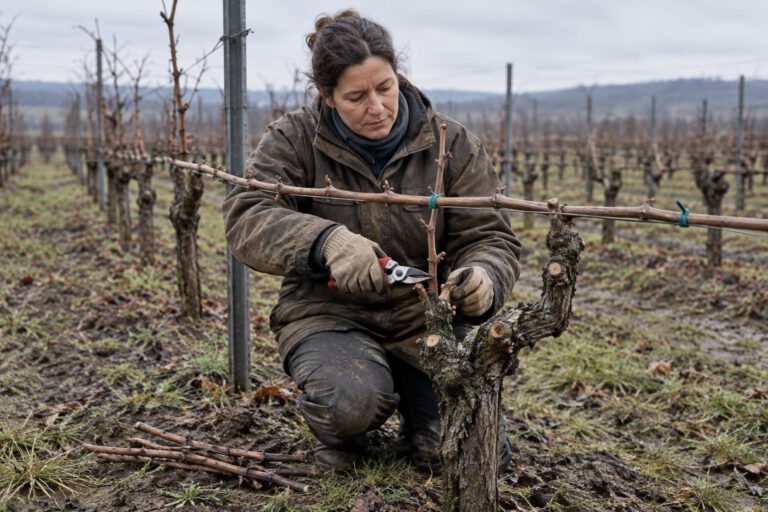
Automation is not a single piece of equipment. It ranges from mechanised operations and sensors that supply information to vehicles that perform a task partly autonomously. A robot can follow a predetermined route; only its interaction with an implement, sensors and a control system turns this into a working process. People remain essential: for planning, supervision, maintenance and decisions that cannot reliably be delegated to a machine.
Obvious tasks include mowing cover crops and mechanical weed control beneath the vines. Repetition and tight working windows make these activities potential applications. ISObot, a research project at Hochschule Geisenheim University, is investigating how field robots, implements and machinery management can work together more effectively. For viticulture, a control system is intended to monitor and adjust the weeding operation and document the quality of its work. This is a development goal, not evidence that a system already operates reliably and profitably on every estate.
Data are not yet a decision
Cameras and other sensors can collect information about the vines. This makes it possible to identify differences within a plot and provide a more targeted basis for decisions on matters such as irrigation or the timing of an operation. But a measurement is not yet a recommendation for action: it must be taken at the right time, analysed meaningfully and combined with knowledge of the vines, soil and weather.
Crop protection is another potential application for more precise technology. Sensors can help tailor treatments to the vines; Hochschule Geisenheim University is investigating sprayers and multicopters, among other technologies. This does not automatically mean that less product is used or that a treatment works better in every situation. What matters is the specific technology, the conditions in which it is used and an assessment of its effectiveness.
Acreage and slopes change the calculation
A machine that can work for several hours on a flat, continuous area cannot simply be transferred to small or steep plots. Gradients, irregular rows and restricted access place different demands on stability, navigation and workplace safety. For steep-slope viticulture, Geisenheim is investigating technical methods with an explicit focus on working hours and full costs.
Nor does the investment end with the purchase price. Maintenance, training, transport, software and the time needed for planning and supervision must also be factored in. On small areas, a machine may be underutilised. Cooperation between estates or using a contractor can offer an alternative to owning equipment; whether this is suitable depends on availability and scheduling. Reliable general cost figures cannot be given without details of the estate, equipment and acreage.
Sharing the work, not pressing a button
The most promising question is therefore not whether technology will take over the vineyard. It is: which recurring, physically demanding or time-critical task can it usefully support under the particular conditions? Where rows and terrain allow machinery to be used, automated operations can ease the workload. Where plots are steep, small or difficult to reach, technology and human labour need to be combined differently.
The benefits only become clear in day-to-day use: does the equipment work reliably, can it be integrated with existing machinery, and does it genuinely save time or money over several years? Such questions require testing under real operating conditions. The vineyard of the future will therefore not emerge from more powerful robots alone. It will emerge where technology fits the landscape and workflow – and where people understand its limitations as well as its capabilities.
Original reviewed by the editors · 6 November 2026