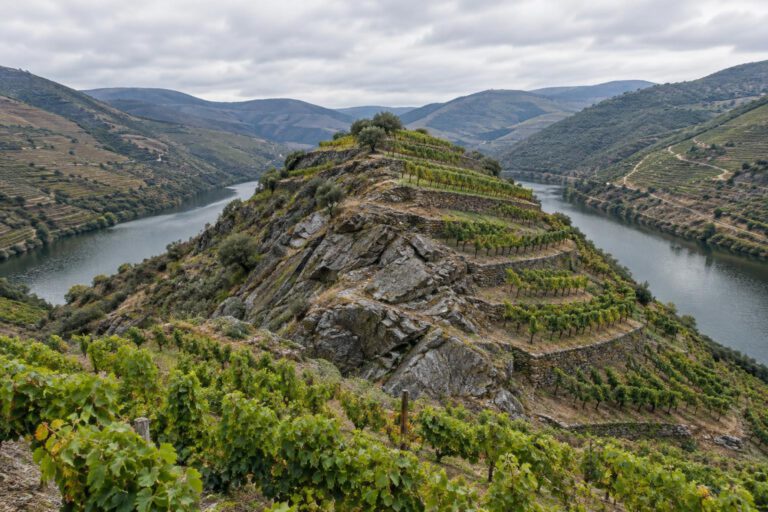
Water often arrives at the wrong time: after prolonged dry spells, heavy rain can hit parched, sloping soils. Some of it then runs rapidly over the surface and can carry soil away, rather than soaking in where vines and the landscape could make use of it later. Germany’s Federal Statistical Office describes the 2026 winegrowing year as marked by drought and heat; the harvest estimate published in the autumn is a forecast, not a final assessment.
Keeping water in the landscape for longer is therefore about more than how individual vineyard rows are managed. Where rain falls, how it flows across tracks, woodland, vineyards and ditches, and where it can be slowed often involve several properties and areas of responsibility. This is precisely where the organisational work begins.
From rapid drainage to slower runoff
In many vineyard areas, drainage channels were designed to carry rainfall off the slopes as quickly as possible. At Geisenheimer Fuchsberg in 2023, a concrete channel was broken up in cooperation with Stadtwerke Geisenheim and replaced with a winding channel lined with natural stone. Individual trees complement the redesign. According to Hochschule Geisenheim University, this is intended to increase infiltration and reduce surface runoff. That is a stated aim of the measure, not evidence of an effect that has already been measured.
Such interventions are not a one-size-fits-all solution. Slope, soil, existing drainage and the use of neighbouring land determine whether a shallow basin, a vegetated runoff strip, an altered channel or better soil cover, for example, makes sense. Vegetated tractor alleys can help the soil absorb water; retention areas or lateral diversions can reduce peak flows. Measures must be planned so that water is not simply displaced onto the next plot or into a settlement at risk.
The catchment, not the plot boundary
Coordination requires land users, local authorities and specialist bodies working in water management, agriculture, forestry and nature conservation. One possible starting point is to map runoff routes and problem areas together, either on the ground or using maps. Suitable measures can then be combined and responsibilities clarified. Interventions affecting watercourses or water runoff may require further assessments and the involvement of the relevant authorities.
In October 2026, the Regionalbüro für Natürlichen Klimaschutz Rheinland-Pfalz offered training days on water retention in open countryside in Schöneberg and in woodland in Hachenburg. These events show that knowledge sharing is intended to bring different land uses together; on their own, however, they demonstrate neither the implementation of specific projects nor their success. In the Soonwald-Nahe region, a guide also brings together measures, practical examples and details of relevant contacts. Its underlying principle is that many small, coordinated interventions can together achieve more than isolated measures.
Who pays – and who checks?
There is no standard formula for sharing costs. Depending on the land, the body responsible and the measure, different funding routes may be available; local authorities, land managers or other partners may also be involved. The Schwammregion guide lists funding opportunities for agriculture and viticulture, as well as for municipal and landscape measures. This does not, however, establish a universally applicable funding arrangement for any specific project. Ownership, maintenance beyond the construction phase and potential losses of yield or land must therefore be clarified before planning begins.
Nor can effectiveness be judged solely by whether a shallow basin holds water after rain. A robust assessment would require, for example, observations of runoff, erosion and soil moisture before and after the intervention – ideally across a range of weather conditions. The information consulted contained no independent series of measurements for the Geisenheim examples. Water retention cannot prevent drought or flooding. But when planned to suit the site and maintained collectively, it can help slow runoff and keep water in the cultivated landscape for longer. The key is not to consider vineyards, woodland, tracks and municipal boundaries in isolation.
Original reviewed by the editors · 6 November 2026