Monika Christmann’s professional path leads from the Institute of Oenology in Geisenheim to the international bodies of the wine world and back again. This movement represents more than an academic career: cellar questions become questions of shared rules – and international debates must be judged by whether they stand up to scrutiny in research and practice.
Christmann is due to receive the Professor-Müller-Thurgau-Preis in Geisenheim on 6 November 2026. The planned evening comes at a time of transition: the university has announced her retirement. It is therefore an occasion to look back, but also to ask how oenological knowledge can have an impact beyond a single cellar or country.
From the cellar to science
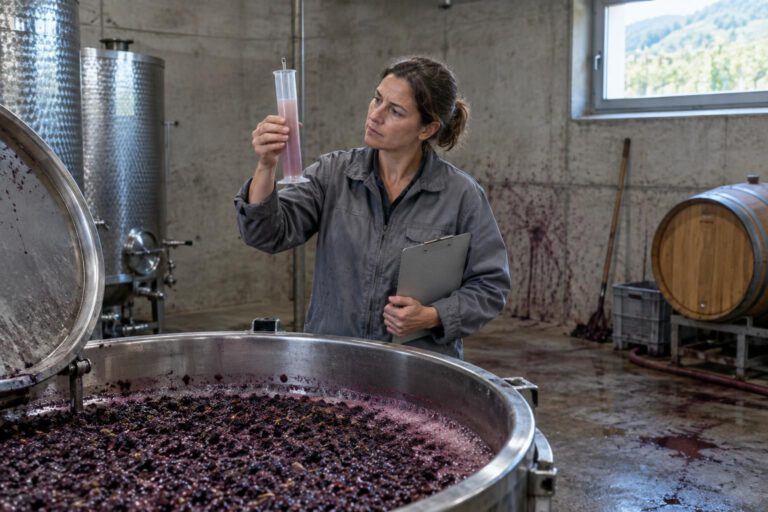
Christmann is an oenologist: a scientist specialising in winemaking. At Hochschule Geisenheim University, she headed the Institute of Oenology. The discipline ranges from fermentation processes and wine constituents to technical procedures and their analytical monitoring. It connects the foundations of natural science with decisions that will later be made in the cellar.
This close connection to practice matters: a process is not worthwhile simply because it is technically possible. It must also be reliably measurable, placed within a legal framework and understood in the context of different winemaking conditions. Christmann’s scientific work encompasses, among other things, new oenological technologies and research into constituents and additives. The university documents collaborative research and publications in these areas; they demonstrate a field of research, not automatically a single, fully developed solution for the industry.
The OIV as a forum for agreement
A key route to the wider world was through the International Organisation of Vine and Wine, or OIV. The intergovernmental organisation brings together scientific and technical expertise and develops recommendations and standards for the wine sector. Christmann held leadership roles there and was appointed Honorary President in 2021. The OIV is not a global legislator: its resolutions do not replace national or regional wine laws. Yet shared definitions and procedures can facilitate exchange between countries.
The question of water in oenology illustrates how demanding this work is. An OIV report, for whose working group Christmann served as rapporteur, examined technical requirements, differing national rules and the limits of analytical detection. Water can play a role, for example, in dissolving authorised processing aids; at the same time, EU law prohibits its addition unless there is a specific technical need. The report makes clear why an international debate cannot stop at a term such as “dilution”: measurement methods have limits, and new processes can affect analyses.
Standards are negotiated
This reveals a less visible side of oenology. Specialist knowledge gains international influence not only when it is generated in a laboratory, but when it is translated into clear terminology, testing methods and rules. That requires scientific precision – and a willingness to acknowledge uncertainties. A standard is the outcome of agreement among experts, not proof that all countries share the same interests or conditions.
Christmann’s career exemplifies this work of building bridges between academia, the wine industry and international bodies. At the same time, it offers no grounds for glossing over conflicts: in questions of winemaking, technical feasibility, consumer expectations and legal frameworks intersect. That is precisely why there is a need for reasoning that is open to public scrutiny, and for a distinction between a scientific recommendation and a binding regulation.
The planned award evening in Geisenheim honours a long career. Its professional significance extends beyond the accolade: wine knowledge provides a sound basis for international practice when research is presented not as a ready-made answer, but as the foundation for verifiable, jointly negotiated decisions.
Original reviewed by the editors · 6 November 2026