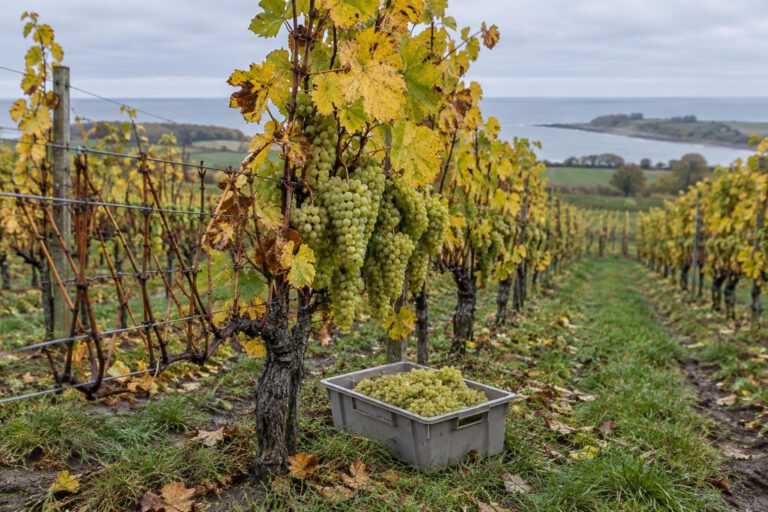
The main grape harvest in Germany began exceptionally early in 2026. Alongside sugar content, the German Wine Institute cited fruit acidity as a criterion for picking dates: acidity levels in the grapes should not be allowed to fall too far. This provides a concrete starting point, but not yet a comprehensive assessment of the vintage. What individual producers actually measured and decided depends on grape variety, vineyard and intended style.
The available harvest reviews from the Verband Deutscher Prädikatsweingüter describe regional differences in the course of the harvest and its assessment. They do not, however, provide comparable acidity analyses of individual musts. The early harvest alone therefore offers no basis for inferring either a general shortage of acidity or a uniform recipe for the cellar.
One measurement does not decide everything
Assessing ripeness is not just about how much sugar the berries contain. Acidity influences flavour and freshness, and its trajectory can change during ripening. Waiting too long to harvest can, in certain circumstances, compromise the desired acidity. Conversely, “as early as possible” is not a universal rule: ripeness and grape condition, weather, grape variety and the producer’s objectives also matter.
In the cellar, acidity is first assessed analytically. Total acidity describes the titratable acids in the must or wine, usually expressed in grams per litre. The pH value, by contrast, measures the strength of the acidic reaction. It is not simply another way of expressing the same figure: two musts with similar total acidity can have different pH values. Both measurements are therefore useful in making an assessment.
Nor can the eventual sensory impression be read directly from an analysis. Residual sugar, alcohol, extract – the wine’s dissolved constituents – and maturation influence how acidity works within the whole. The practical oenology guide published by the Dienstleistungszentrum Ländlicher Raum Rheinland-Pfalz therefore recommends taking the intended style and sensory assessment into account alongside analytical results when making decisions about young wine. Measurements provide guidance; they do not replace an assessment of the specific batch.
From must to young wine
Some decisions are made early, others only after fermentation has begun. Acidity can change during processing: potassium and tartrate precipitation, among other factors, can play a part. Malolactic fermentation, in which lactic acid bacteria convert certain acids, is another possible influence – provided it suits the wine and the intended style.
Deacidification is not automatically appropriate for every high-acid batch; equally, an early harvest does not mean that a must necessarily needs acidification. Methods and permitted quantities are governed by wine law and depend, among other things, on the product and region. Acidification and deacidification are not corrections that can be combined at will. Producers must check the applicable rules before taking specific measures.
In practice, this means first analysing the batch, then assessing it in the context of the planned maturation, and finally weighing up whether any intervention is needed at all. When deacidifying young wine, for example, stability may also need to be considered; following treatment, the wine may require time before further processing. The appropriate course of action therefore cannot be determined from a single acidity reading.
What can be said about 2026
The DWI explicitly made acidity part of the decision on harvest ripeness during the unusually early harvest. The VDP review reports differing experiences in individual regions, including stable or moderate acidity levels. These are assessments from the producers concerned, not a comprehensive series of measurements. A reliable comparison of specific values for 2026 is not possible on the basis of these sources.
The crucial question after harvest is therefore not simply: “How much acidity does the vintage have?” Rather, it is: what acidity does each batch bring, how does it develop in the cellar, and what kind of wine is it intended to become? Only when analysis, tasting and the intended style come together does an early harvest translate into a well-founded cellar decision.
Original reviewed by the editors · 5 November 2026