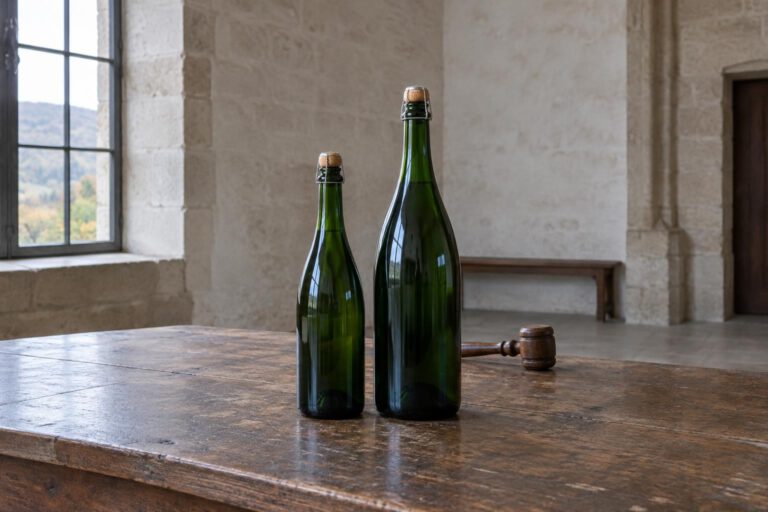
On Saturday, 7 November, bidding returns to the Museum Römerhalle in Bad Kreuznach: VDP.Nahe is hosting a wine auction featuring estates from the Nahe, the Ahr, Rheinhessen and the Pfalz. A pre-auction tasting is scheduled for the morning, with the so-called wet auction, where wines are tasted during bidding, due to begin at 1pm. On offer are 30 lots from 14 estates – including Rieslings appearing in more than one bottle format.
This raises a seemingly simple market question: how much more does the larger bottle fetch? A reliable answer cannot be gleaned from the highest hammer price for a magnum or double magnum. It requires a comparison that takes account of the volume of wine, the lot size and, wherever possible, the vintage and wine as well. The results were not yet available at the editorial deadline.
Price per litre is the common denominator
The first calculation is straightforward: divide the hammer price by the total volume of wine on offer. For a lot containing one 0.75-litre bottle, the price is divided by 0.75; for a 1.5-litre magnum, by 1.5. Where there are several bottles, the total volume in the lot is what counts. This produces a hammer price per litre that can be compared across formats.
To calculate the relative premium, the price per litre of the larger format is then compared with that of the smaller one. If the magnum’s price per litre is 20 per cent higher, for example, that would represent a premium of 20 per cent per litre, all other things being equal. This is a method of calculation, not a forecast for the auction. It must also be clear whether the figure is the hammer price alone or the amount including commission, taxes and other costs. Different pricing bases must not be mixed.
Same wine, same vintage?
The catalogue offers starting points, but not automatically a controlled comparison. For example, Emrich-Schönleber’s “Auf der Ley Riesling GG” (Großes Gewächs, a top dry wine from a classified vineyard) and Schäfer-Fröhlich’s “Final Riesling trocken” are each listed for the 2025 vintage in 0.75-litre bottles, magnums and double magnums. Dönnhoff’s “Brücke Riesling GG” is offered from the 2025 vintage in 0.75-litre bottles and magnums. Such combinations allow a closer comparison than simply setting unrelated large-format bottles against one another.
Yet even within the same wine name, it remains necessary to check whether the vintage, specific bottling and lot conditions match. A larger bottle from a different vintage is not a direct comparison with the smaller one. Lots may also differ in the number of bottles offered. A single rarity can fetch a high hammer price; a lot containing many bottles may be subject to different bidding dynamics. The result then reflects more than just the format.
A record price is not the same as a format premium
The results of the 2025 Nahe auction published by the VDP show how significant this distinction can be: a hammer price of 11,000 euros was reported for a 3-litre double magnum of Keller’s “PETTENTAL Riesling GG”. That is an impressive sum, but on its own it does not prove that the large format was more expensive per litre. To establish that, the same wine – ideally from the same vintage and under comparable lot conditions – would also need to be assessed in smaller formats.
A meaningful comparison after the auction should therefore disclose three things: the hammer price per lot, the number of bottles it contains and the resulting calculated price per litre. Fees and taxes should also be shown separately. Only then will it become clear whether larger bottles actually fetched a higher price per litre – or whether a high total hammer price was mainly down to the greater volume of wine, the rarity of the lot or particular demand.
The auction in Bad Kreuznach offers several potential pairs for comparison. Whether these reveal a clear format premium will only become apparent once the hammer prices and full lot details are available after the auction. Until then, the precise answer is this: the larger bottle may cost more; whether it also fetches more per litre still needs to be calculated.
Original reviewed by the editors · 6 November 2026