From 12 to 14 November, the winegrowing world’s attention turns to La Gomera: the island is hosting the III Jornadas Técnicas Internacionales de Vitivinicultura Sostenible, an international technical conference listed on the calendar of the International Organisation of Vine and Wine (OIV). It is organised by the Cátedra de Agroturismo y Enoturismo de Canarias of the University of La Laguna and the Canary Islands Institute of Food Quality, together with the Cabildo of La Gomera. This is about more than a green label: what must a winegrowing business demonstrate when it describes its work as sustainable?
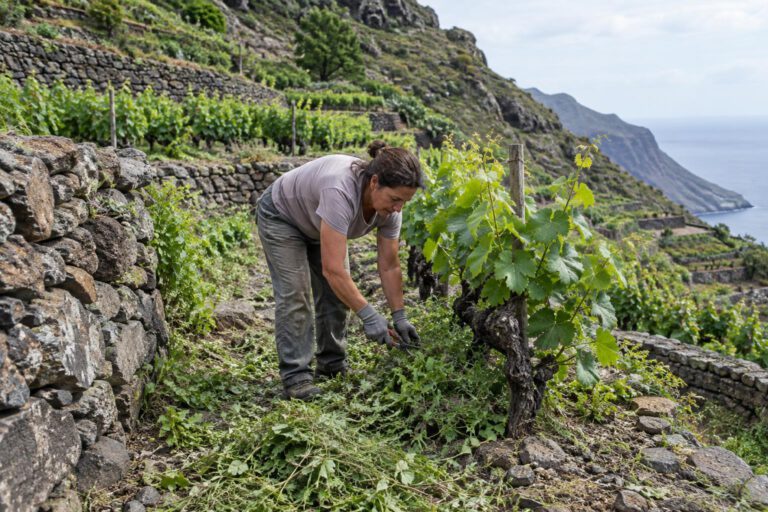
On the island, this question is particularly tangible. La Gomera is steep, with small, fragmented plots; vines grow on terraces and slopes supported in many places by dry-stone walls. This makes cultivation labour-intensive and restricts machinery access. The DOP La Gomera protected designation of origin covers the island. Yet origin alone is no proof of sustainability. What matters is the actual impact of vineyard management — on water and soils as well as on people and operating costs.
An assessment, not a buzzword
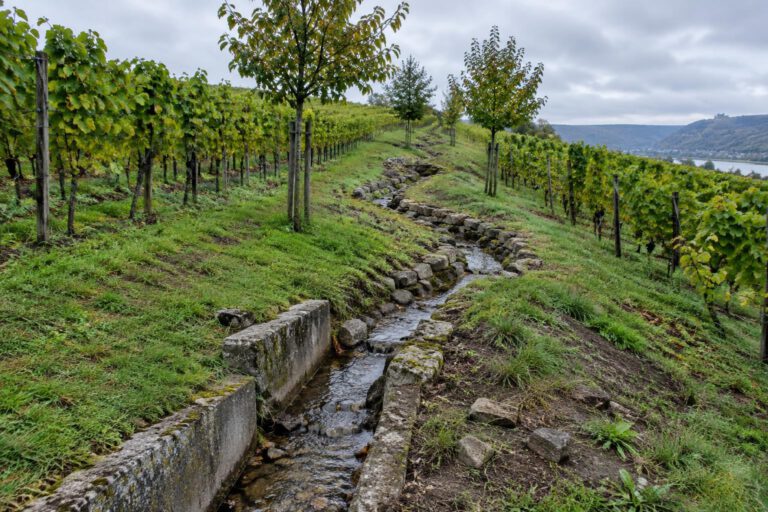
For water consumption, simply stating the volume that reaches the vineyard is not enough. A transparent assessment would be more meaningful: how much water is used per unit of area and per quantity harvested, where does it come from, and how do demand and yield vary between years? Soil management and vineyard vegetation can also influence the assessment. These questions serve here as evaluation criteria, not as predetermined findings about businesses on La Gomera.
Transport and energy would need equally careful scrutiny. Island wine production may involve journeys for bottling, packaging and access to markets that differ from those of a mainland business. At the same time, an assessment is only fair if it clearly defines which journeys and stages of production it covers. Without comparable reference points, simple claims — such as ‘regional’ or ‘resource-efficient’ — risk promising more than the data can support.
Labour must be counted too
Sustainability is not solely a matter of environmental footprint. On steep plots, manual work takes time; accessibility, wall maintenance and the availability of labour determine whether cultivation is viable in the long term. A more comprehensive approach would therefore consider environmental impacts alongside economic viability and social conditions. Which indicators are suitable also depends on whether they can be collected at business level and compared over several years.
The organisers have framed the conference around sustainable or regenerative winegrowing. The Cabildo announced an extensive technical and academic programme; full details had not yet been published at the time of writing. It is therefore not yet possible to say which specific case studies or measurement methods will be discussed. This is precisely the journalistic test for this preview: a commitment to sustainability does not make a method verifiable; that requires transparent criteria, robust data and an assessment that does not ignore trade-offs.
Three days on La Gomera
The conference takes place from 12 to 14 November 2026 on La Gomera. According to the organisers, it will focus on the challenges facing winegrowing in the context of climate change and water scarcity; the presentation of the ‘Vitivinicultura Sostenible 2026’ award has also been announced. The exact venue on the island was not specified in the information reviewed. For the region, the gathering is an opportunity to bring the distinctive work in its vineyards into a wider debate — and for wine professionals to discuss sustainability there not as a label, but as a verifiable practice.
Original reviewed by the editors · 5 November 2026