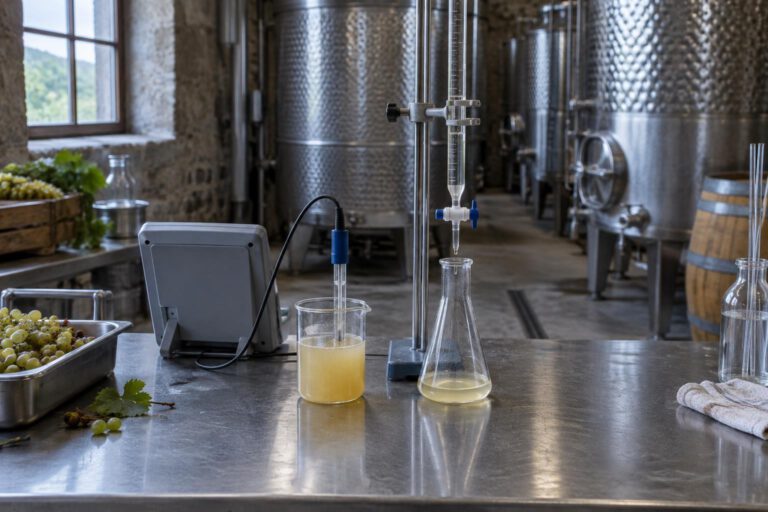
Food safety in the wine cellar does not begin with bottle inspection. It depends on many transitions: from grape reception to must, from tank to bottling, from cleaning to the next use of a hose or pump. At these handover points, hygiene, working routines and documentation come together. Who checks whether they work in concert?
A forthcoming talk by Geisenheim University at BrauBeviale in Nuremberg addresses precisely this connection: on 12 November 2026, Thomas Schiemann will speak at the university’s stand about the importance of food safety in beverage technology. For wine producers, the underlying question is an everyday concern – and a clean cellar alone does not provide the answer.
Responsibility remains with the business
The basic rule of EU hygiene law is clear: primary responsibility for food safety lies with the food business. Authorities check compliance with the regulations, but do not assume responsibility for day-to-day operations. The German Wine Ordinance also refers to food hygiene requirements for the commercial processing, storage and placing on the market of wine products.
A winery must therefore establish who is responsible for each procedure. In a small business, one person may combine several roles. What matters is less an extensive organisational chart than clear responsibilities: who sets cleaning procedures? Who checks whether they have been followed? Who responds when a check reveals a problem? This may be the business manager, the person in charge of the cellar or a trained employee – delegating tasks does not remove the company’s responsibility.
HACCP: identifying and controlling risks
Processing generally requires a permanent procedure based on HACCP principles. The abbreviation stands for a system for analysing potential hazards and controlling key process steps. The aim is to identify risks, establish suitable measures and verify their effectiveness. This does not automatically mean external certification.
In the cellar, this assessment might ask: where could a product become contaminated? How is the cleaning of tanks and pipework assured? Which checks are appropriate for bottling or storage? The answers must reflect the actual operation. Not every task is a “critical control point” – a process step at which a specific hazard must be managed through particular controls. Good hygiene practice, such as appropriate cleaning and trained staff, provides the foundation.
Keeping records so checks can be followed through
Records make operational procedures traceable. Depending on the risk and procedure, these may include cleaning records, maintenance documents or the results of specified checks. A list is not an end in itself, however: it is only useful if entries genuinely reflect the procedure and deviations lead to action. If cleaning is not carried out as intended, it must be clear who decides whether equipment needs to be cleaned again or a process stopped.
Gaps can easily arise at precisely these handovers. The person who releases a tank for use may not be the one who fills it. An external service provider may maintain equipment, but the business must organise the checks its operations require. A workable system therefore sets out not only tasks, but also how information is passed on and deviations are addressed.
Internal checks and official inspections
Official food control authorities inspect businesses in accordance with legal requirements. They may also examine whether hygiene procedures are implemented in everyday practice and whether the documentation reflects this. This neither replaces the business’s own checks nor means that a previous inspection automatically guarantees the safety of every subsequent production step.
The scope of an appropriate procedure depends on the specific activities and risks involved. EU law treats some aspects of primary production differently from subsequent processing; there is therefore no single solution for every winery. For smaller businesses, the practical task is to describe their procedures in a manageable way, assign responsibilities and document checks so that they are actually used in the cellar. The handover point then becomes not an additional piece of paperwork, but the link between what the business does and what it can demonstrate if called upon.
Original reviewed by the editors · 5 November 2026