A high hammer price is a clear figure. Its significance is less clear-cut. When wine goes under the hammer in Bad Kreuznach on Saturday, 7 November 2026, the results will reveal a willingness to pay – but, in the first instance, only for the specific wines on offer under the conditions of this auction.
VDP.Nahe has announced a total of 30 lots from 14 wineries at Museum Römerhalle, Hüffelsheimer Straße 11, with participation from Ahr, Rheinhessen and Pfalz. The pre-auction tasting runs from 9am to 11am; the “wet” auction, which will also be livestreamed, begins at 1pm. A selection of the wines on offer will be poured during the auction. The programme offers a glimpse of selected 2025 wines and older vintages, rather than a representative survey of the vintage.
A lot is not the same as a bottle
A lot is a unit offered for sale separately at auction. It may comprise numerous bottles; private buyers therefore do not have to take the entire quantity. They agree their desired number of bottles with an authorised wine broker, who bids on their behalf.
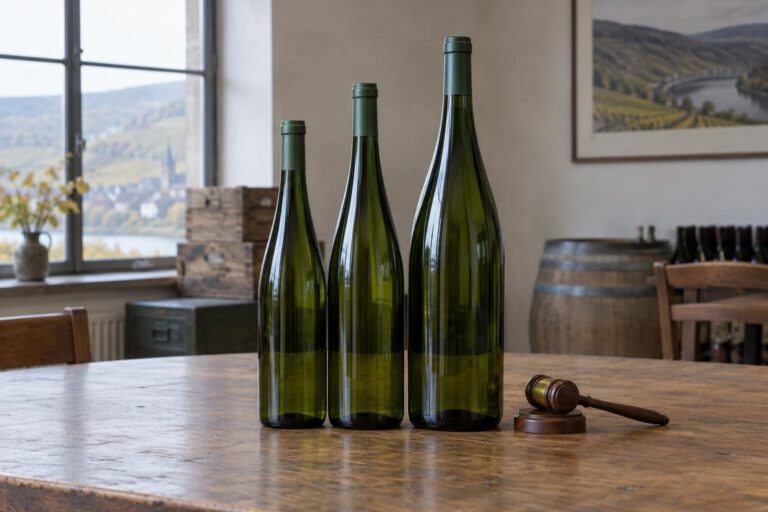
The question of size is illustrated by the 2025 Riesling GG (Großes Gewächs, a dry wine from a top classified vineyard) “Auf der Ley” from Emrich-Schönleber in Monzingen on the Nahe. Under N14 to N16, the catalogue lists a total of 360 bottles of 0.75 litres, 60 magnums of 1.5 litres and six double magnums of three litres. As of 5 November 2026, the opening prices per bottle are 100, 200 and 500 euros respectively, before additional charges. These are starting prices, not achieved results.
This pricing structure alone shows that the double magnum starts at more than four times the price of the standard bottle, although it contains four times as much wine. For comparison, prices can be converted to a 0.75-litre equivalent. But that does not remove the differences in scarcity between formats. A subsequent premium would therefore not automatically mean a higher price for the same litre of wine.
Bidding through intermediaries
Under the auction conditions, only recognised wine brokers may bid. The bidding instruction specifies the desired wine, the number of bottles and the price limit. This limit is a ceiling, not a compulsory purchase price: the broker is expected to secure the wine as cheaply as possible within the terms of the instruction.
Different elements of the price also need to be distinguished. According to the conditions, a five per cent commission is added to the hammer price, along with shipping and other charges where applicable; VAT must also be taken into account. A published auction price therefore cannot be compared with a retail price without first clarifying how it has been calculated.
What matters after the hammer falls
Any subsequent analysis should first ask: what quantities were actually auctioned, at what prices and in which formats? A decline in volume can accompany a higher average price. Conversely, greater proceeds may simply reflect a larger offering. Charity lots should be considered separately: here, willingness to pay for wine cannot be neatly separated from the desire to donate.
A comparison of comparable lots over several years, each with its quantity, format and an identical pricing basis, would therefore be more meaningful than the highest individual price. Even then, it describes only this segment of the market. The hammer price alone reveals neither how many end customers a broker represents nor how easily the wine might subsequently be resold.
The broader sales market provides the necessary counterpoint: according to the German Wine Institute, both the volume of wine purchased in Germany in 2025 and the resulting sales revenue fell by around seven per cent compared with 2024. The figures are based on a NielsenIQ analysis commissioned by the DWI. A high auction price would not contradict this finding. Rare wines can be in demand while less wine is being bought overall. The Nahe auction thus offers an illuminating window onto the market – but not a picture of the entire wine industry.
Original reviewed by the editors · 5 November 2026