After the 2026 harvest, Thomas Huber faces more than just the question of how much wine is in the cellar. The winemaker at Vienna’s Fuhrgassl-Huber estate has announced plans to reorganise the water supply to its vineyards. In an interview with Falstaff PROFI, he put the harvest at around 35 to 40 per cent below the long-term average. In response, the estate intends to expand drip irrigation – initially, however, only where wells or existing water networks are available.
This sounds like a pragmatic response to an urgent problem. How effective it will be, however, depends on details that have not yet been made public: which plots will be connected, for example, how much water is available and what investment is needed.
Viennese viticulture between city and hillside
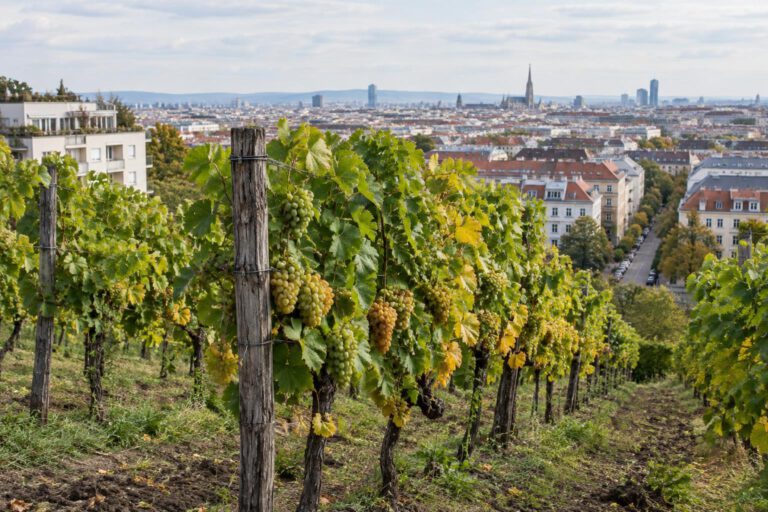
Fuhrgassl-Huber is based in Neustift am Walde, in Vienna’s 19th district. The estate describes its vineyards as lying entirely within Vienna’s city limits; 14 hectares are said to be steep hillside sites with gradients of more than 25 per cent. Stadtlandwirtschaft Wien lists 26 hectares in Neustift am Walde and five hectares on the Nußberg and in Grinzing as parts of the holding. As these figures do not account for all the estate’s land, they do not provide a consistent total area.
Wiener Gemischter Satz DAC is part of the estate’s identity. According to its website, almost half of its vineyard area is devoted to this designation of origin. Different grape varieties grow together in the vineyard and are harvested and processed together. For this traditional approach to cultivation, dry soil presents a challenge that cannot be pinned down to a single variety or plot alone.
Drips rather than blanket watering
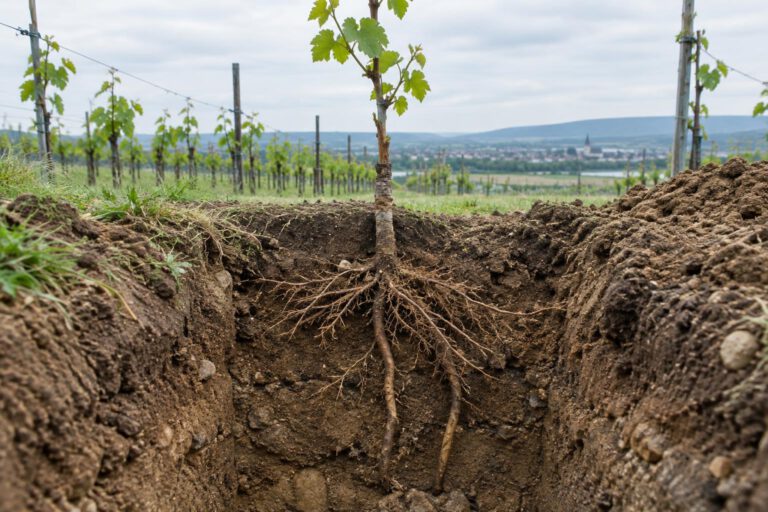
Huber describes the planned technology as drip irrigation: hoses are to deliver water directly to the vines. Expansion is to begin where wells or water networks already exist. This is an important qualification: a technical installation does not itself create a water resource. The interview does not specify which wells and networks are meant, how their capacity will be assessed or which permits apply.
Huber gives no figures for costs, construction time or scale either. The choice of plots is therefore likely to be crucial. The information available does not establish whether younger vines, particularly dry plots or specific hillside sites will be prioritised. Nor is there any documented indication of how often irrigation will take place or which measurements will guide it. Huber’s reference to adjusting water applications to the weather remains a general principle, not a published irrigation plan.
Irrigation is no substitute for observation
In 2026, the Federal College and Research Institute for Viticulture and Pomology in Klosterneuburg noted that drought had contributed to smaller berries, lower yields and sunburn damage. The specialist body also stresses close observation of the vines and appropriately adapted vineyard management. This does not make irrigation unnecessary, but places it in a broader context: targeted water use requires an assessment of the needs of the individual vines and soils.
Any complementary measures planned by Fuhrgassl-Huber – in soil management or cover cropping, for instance – are not publicly documented. Huber’s rationale for the expansion is economic: the required production volume cannot simply be secured by adding more vineyard land. He also says that irrigation costs should be considered over several years, rather than just one poor harvest. That is a business calculation, not a guarantee that water will always be available in future or that irrigation alone will be enough.
A decision with variables still unresolved
The current plan is therefore less a finished system than a direction of travel: targeted drip irrigation, starting at sites with existing infrastructure. A robust assessment of the new water supply still requires details of the source and volume of water, costs and timetable, and the first plots to be connected. For now, only the reason is clear: after a harvest that Huber puts well below his long-term average, the estate wants to give its vines better protection against a lack of rain – step by step and apparently not everywhere at once.
Original reviewed by the editors · 7 November 2026