A lifetime achievement award looks back. In Paul Fürst’s case, that retrospective also leads us into an estate where the next generation has long shouldered responsibility: Weingut Rudolf Fürst in Bürgstadt is run by Paul and his son Sebastian. On 3 November 2026, the VINUM Weinguide Deutschland 2027 made Paul Fürst the first winegrower to receive its lifetime achievement award.
What endures when an estate is passed down through the generations? Not simply a set of inherited rules. Rather, a body of experience that continually encounters new conditions in the vineyard and cellar. How Paul and Sebastian Fürst negotiate individual decisions between them is not publicly documented. What is apparent, however, is the focus of their work: the distinctive characteristics of their vineyard sites and a precise, hands-on approach to cultivation.
Bürgstadt and its red sandstone
According to the German Wine Institute, the family has been growing grapes in Bürgstadt for almost 400 years. Paul and Monika Fürst built new estate premises there in 1979; Paul and Sebastian have run the estate together since 2007. The VDP now lists 22.8 hectares of vineyards and describes red sandstone overlain with loam and clay as the defining geology.
The vineyards span several towns and origins. The sites listed by the VDP include Bürgstadter Centgrafenberg and Hundsrück, as well as Klingenberger Schlossberg and Karthäuser in Volkach. The estate’s profile is strongly shaped by the Pinot family: according to the VDP, Spätburgunder (Pinot Noir) and Frühburgunder (Pinot Noir Précoce) account for 60 per cent of the vineyard area; Riesling, Weißburgunder (Pinot Blanc), Silvaner, Chardonnay and other varieties complete the range. These figures reflect the estate’s published position, not an unchanging breakdown.
Manual work as a daily choice
Soil and slope help determine how a vineyard can be cultivated. In his account for the VDP, Sebastian Fürst describes tailoring the work to the microclimate and geology: on steep terraces, the soil is tended with a hand hoe and fertilised with compost produced on the estate, alongside diverse cover crops and herbicide-free cultivation. These are concrete decisions, not an abstract formula for tradition — and they must prove their worth in every parcel.
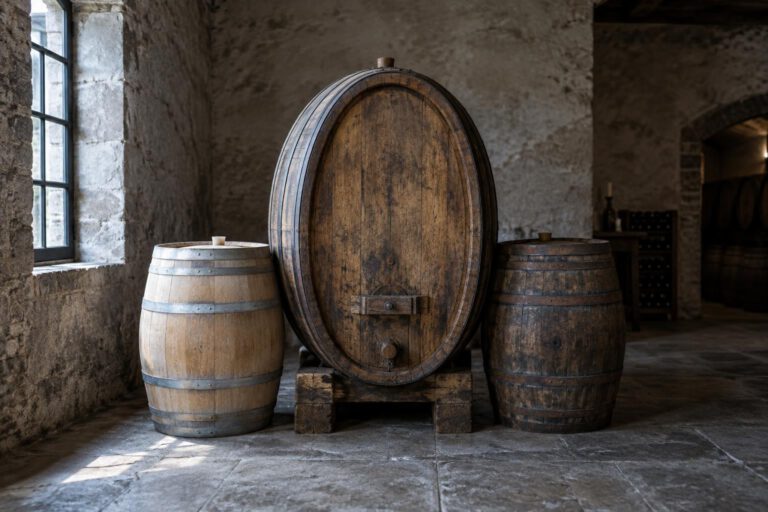
The VDP also describes a restrained approach in the cellar: extended lees ageing, slow clarification through ageing in pièce barrels, and bottling without filtration. Paul Fürst describes the aim for the Pinots as moderate extraction and longer maturation in small wooden barrels. These details reflect the estate’s stated working methods; they are not an independent assessment of individual wines.
Experience is not a ready-made doctrine
In his own account for the VDP, Paul Fürst began helping in the vineyards and on the farm as a child. In 1971, he started an apprenticeship at Schloss Johannisberg. He recalls being impressed there by mature vintages. His career thus combines practical experience at the family estate with training outside Bürgstadt — a path that shows that passing things on means more than preserving them.
Today, the division of roles points to shared responsibility: the VDP lists Paul and Sebastian as owners, and Sebastian also as cellar master. Without recent conversations with both men, it is not possible to describe more precisely what this means in day-to-day practice. Yet their work in the vineyards makes clear what guides their decisions: site, soil and vintage, rather than inherited prescriptions alone.
The lifetime achievement award honours Paul Fürst’s many years of work. At the same time, it draws attention to an estate whose future does not depend on any single accolade. That future takes shape in the recurring task of passing on experience and testing it where the grapes grow: on the steep slopes and parcels around Bürgstadt and beyond.
Original reviewed by the editors · 7 November 2026