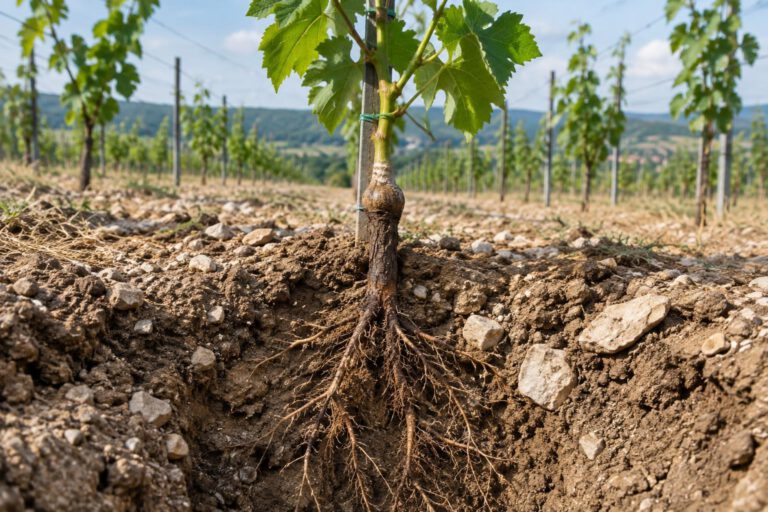
A new vineyard begins with more than just the question of Riesling or Spätburgunder. Below the graft union sits a second genetic component: the rootstock on which the chosen grape variety grows. It remains hidden in the soil but influences how roots and shoots develop – and thus how the vine can respond to its site.
The fact that this underground architecture differs from one rootstock to another is the subject of Lukas Steng’s research. On 13 October 2026, Hochschule Geisenheim University announced the completion of his doctorate. The publicly available university announcement gives the title of his thesis but no results. A peer-reviewed Geisenheim field study from 2025, to which Steng contributed, offers a concrete insight into the research question and its potential significance. It is one element of the research, not necessarily a summary of his entire doctoral thesis.
The vine consists of two partners
The European grapevine is usually grafted: the above-ground part – the scion – carries the chosen variety. Below it, the rootstock forms the root system. This practice dates back to the phylloxera crisis of the 19th century. Many rootstocks derive from American vine species or crosses between them, whose roots are resistant to phylloxera. The rootstock is therefore far more than a biological base. It can help shape the vine’s growth and its supply of water and nutrients.
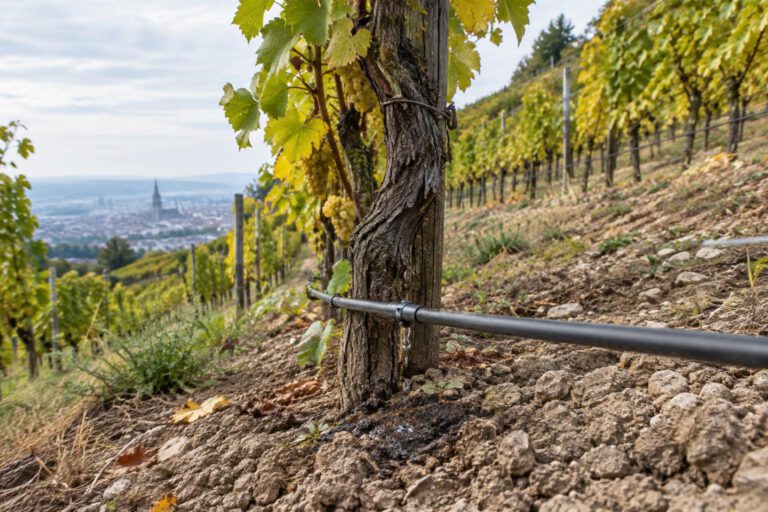
Yet “Which rootstock is right?” is not a question that can be answered by a single characteristic. Soil, water availability, lime content, desired vigour and the characteristics of the scion all interact. The decision is made when the vineyard is planted – and has an impact for many years. Establishing the root system is particularly crucial for young vines: according to the German Wine Institute, young vineyards struggled especially with water shortages during the dry summer of 2026 because their root systems were less developed.
Measuring roots in three dimensions
Studying roots in the field is labour-intensive. They are hidden in the soil, branch out in three dimensions and cannot simply be dug up in their entirety without losing parts. The published study addressed this difficulty through targeted excavation and digital 3D recording. It examined Riesling vines on three rootstocks: 101-14, SO4 and Richter 110. In total, the team recorded 96 vines at four points during the first 18 months after planting.
The results show differences in spatial form and biomass distribution between the genotypes studied. In the trial, Richter 110 developed particularly deep, more vertically oriented roots; the maximum depth measured was 180 centimetres. The study also reports that root growth in all three variants extended more strongly along the vine row than into the space between rows. Findings such as these help us see the rootstock not merely as a name on a planting certificate, but as part of the architecture of the whole vine.
There is still a step from findings to decisions
A deeper root is not automatically a guarantee against drought stress. What also matters is whether water is actually available in the deeper soil layers, how permeable or compacted the soil is, and how vigorously the vine grows above ground. Root distribution, water uptake and response to drought are connected, but they are not the same thing. Moreover, a trial involving three rootstocks at one site does not reflect the diversity of German vineyards.
The data can therefore provide a basis for improving models and matching rootstocks more precisely to site conditions. They do not, however, offer a simple ranking for practical use. Nor does the doctoral announcement itself cite any results that would support a specific recommendation to winegrowers. That requires the full thesis and further trials across different soils and climatic conditions.
Root research nevertheless shifts the focus to an important place: the soil, where the vine accesses water and nutrients. When planning a new vineyard, the grape variety alone does not determine its potential. The invisible half of the plant also deserves a carefully considered choice – one that takes the soil profile, water balance and the estate’s long-term aims into account together.
Original reviewed by the editors · 7 November 2026