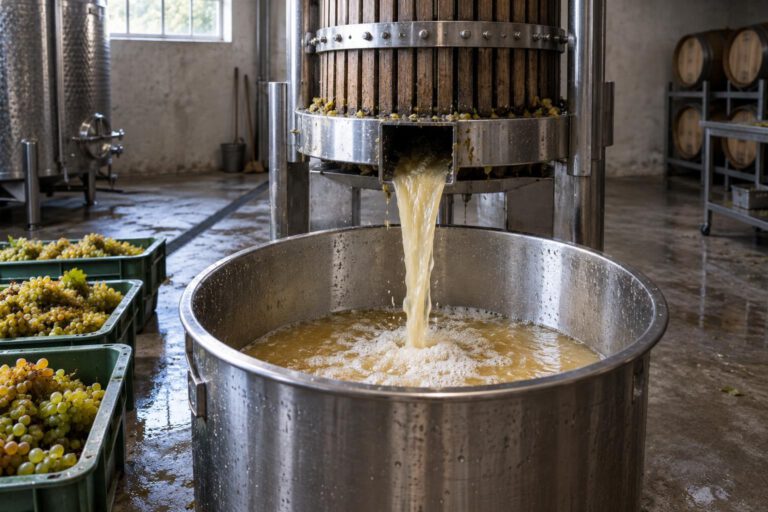
On 30 September 2026, Italy’s cellars held 41 million hectolitres of wine. There were also 12.8 million hectolitres of must and 8.9 million hectolitres of new wine still fermenting. Together, that amounts to more than 62 million hectolitres of liquid in the cellar – but not 62 million hectolitres of finished wine, nor the volume of the harvest just completed.
This is precisely the key to putting harvest forecasts into perspective: production and stocks describe different moments and different categories. Looking at them together reveals more about the market. Simply adding them up risks double counting or comparing things that are not comparable.
A forecast is not yet a final harvest tally
On 2 November, the European Commission estimated Italy’s wine production at 41.1 million hectolitres. WineNews reported this figure as the currently available EU estimate. It is explicitly provisional: it does not establish the final yield. For 2026, Assoenologi and Unione Italiana Vini, together with ISMEA, had refrained from issuing early harvest forecasts; reliable figures were not expected until the declarations had been completed.
The Italian Ministry of Agriculture distinguishes between the annual production estimate based on regional forecasts and the subsequent declarations submitted by producers. Production figures refer to wine and must from the relevant production year; production declarations are due by 15 December. The reporting dates and procedures are therefore more than mere administrative details: they determine which harvest appears in which figure.
September offers a particular view of the cellars
The ICQRF figure for 30 September is a snapshot taken in the midst of processing. At 41.0 million hectolitres, wine stocks were 14.2 per cent higher than on the same date in 2025. Must (+50.5 per cent) and wine still fermenting (+92.8 per cent) also exceeded the previous year’s figures. First and foremost, this means that more was present in the recorded categories on that date. On its own, it explains neither how large the harvest will be nor whether these volumes will subsequently be sold.
The distinction between the categories matters in practice. Must is not yet finished wine; young wine still fermenting remains in the winemaking process. By the reporting date, some freshly harvested grapes have already been recorded as must or fermenting wine, while some may already have been entered as wine. September stocks must therefore not simply be added to the harvest estimate. Without precise distinctions in terms of time period, product status and reporting procedures, there is a risk of double counting.
Stock levels do not equal oversupply
The geographical distribution also adds detail to the national total. According to ICQRF, 57.7 per cent of the wine was stored in the north; Veneto alone accounted for 24.9 per cent. These are stocks held in a particular place on a particular date, not an automatic indication of sales or demand. Stocks also differ by origin category: 56.8 per cent were recorded as DOP wines (protected designation of origin) and 25.3 per cent as IGP wines (protected geographical indication).
A comparison with the previous year shows a change, but does not yet establish a cause. Higher stocks may be linked to a larger harvest, slower sales or the timing of storage – or to several factors at once. ISMEA put Italian production in 2025 at around 44 million hectolitres and pointed to stable stocks at the start of the following production year. This provides context, but is no substitute for the still-outstanding data for 2026 compiled on a comparable basis.
What only the declarations will clarify
Ultimately, the final tally depends not only on how much was harvested, but also on what it became, when it was recorded and what stocks from previous production years remain. The official cellar data provide an important counterpart to the harvest estimate. They show that Italy’s wine industry is handling substantial volumes of wine, must and fermenting young wine in autumn – but not yet how much of this will be accounted for as finished production from the 2026 vintage.
Until the production declarations are available, the figure of 41.1 million hectolitres remains an interim estimate. The proper interpretation is therefore not: Italy has harvested this much wine. Rather: a provisional EU estimate puts production at this level; in parallel, the Italian cellar report documents high stocks at an early reporting date shaped by the harvest. Only when the two data series have been properly aligned in terms of timing and definitions will the figures yield a reliable harvest tally.
Original reviewed by the editors · 7 November 2026