A regional grape variety is more than a name on a label. It can give a wine region a distinctive identity – but only if it grows reliably in the vineyard, is made into convincing wine in the cellar and reaches the people who want to drink it. Tauberschwarz shows how closely these questions are linked. Winzerhof Strebel’s recognition as “Newcomer of the Year” at the 2026 Deutscher Rotweinpreis provides a timely occasion to explore them. The awards ceremony is scheduled for 28 November in Stuttgart; at the editorial cut-off on 7 November, it had not yet taken place.
A variety with regional roots
Tauberschwarz has historical ties to the Tauber and Vorbach valleys. The variety’s precise origins are uncertain. Records of its cultivation in the region date back to the 16th century; the name Tauberschwarz appears in a historical decree from 1726. As winegrowing declined in the valleys, the vine itself almost disappeared. In 1959, around 400 vines were still found in a vineyard near Ebertsbronn. Selective breeding by the Weinsberg teaching and research institute and the commitment of winegrowers helped preserve it.
It is a remarkable story, but not in itself a judgement of quality. Rarity can attract attention; it is no substitute for good work in the vineyard or a wine that finds its place in a producer’s range. The figures show the scale: Destatis lists Tauberschwarz in its vineyard area statistics, recording a total of 16 hectares for 2014. That is a historical point of comparison, not a current acreage figure. More recent data series continue to show its limited extent, though the precise area depends on the reporting year.
What the vine demands in the vineyard
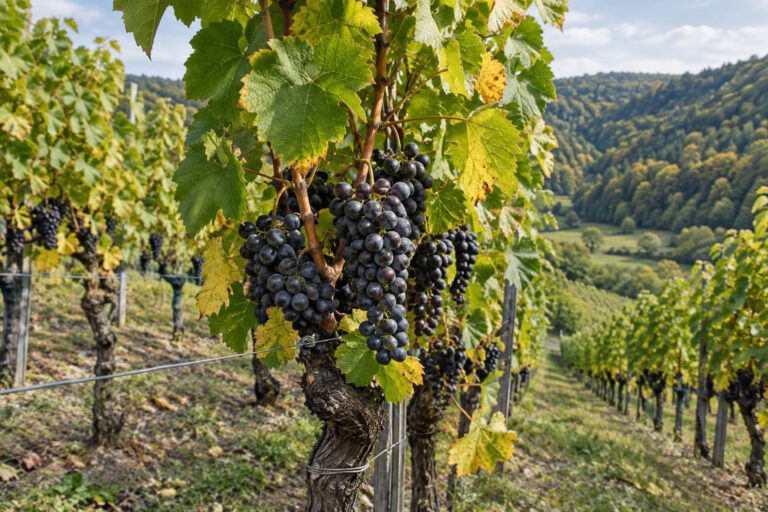
Choosing a regional variety is also a viticultural decision. According to the Weinsberg research institute, Tauberschwarz is considered to have good resistance to winter frost. At the same time, its relatively thin berry skins can increase susceptibility to botrytis at ripening – a fungal infection that can become particularly problematic in damp weather. This does not lend itself to a simple label such as “robust” or “undemanding”: the site, the course of the weather and the work in the vineyard remain decisive.
For producers, this means building experience over several vintages. When to harvest, how to sort the grapes and which approach to winemaking suits them cannot be deduced from the variety’s rarity. Nor does a single award answer these questions. In 2026, the VINUM competition singled out Winzerhof Strebel from Lauda-Beckstein; its Tauberschwarz took fourth place in the “German Classics” category. This recognises one wine within a particular competition framework – it is not evidence that every Tauberschwarz has the same style or quality.
From rediscovery to repeat purchases
The greater challenge is to turn a regional speciality into an offering that remains clear and accessible over time. Small volumes limit how widely a wine can be available. At the same time, its close ties to its place of origin can be a strength if producers explain them clearly rather than selling the bottle on history or exclusivity alone. What matters is that buyers know what Tauberschwarz is and why a producer grows the variety.
That takes more than an award: consistent work from vintage to vintage, a clear style and suitable sales channels – from cellar-door sales to restaurants or specialist wine merchants. The available information about Winzerhof Strebel does not provide a complete picture of how these elements apply there in practice. The award raises the estate’s profile, but provides no information about vineyard area, production volumes or sales.
Tauberschwarz does not need to become a major variety to have a role to play. Its potential value lies in making a wine landscape distinctive and preserving regional experience. Whether that translates into a viable future depends less on the story of its near-disappearance than on the work that follows year after year – in the vineyard, in the cellar and in dialogue with the market.
Original reviewed by the editors · 7 November 2026