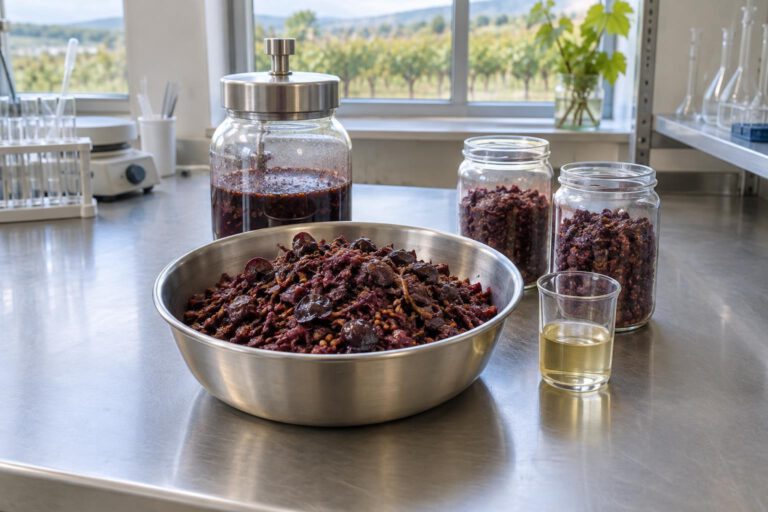
What remains after pressing could acquire new value for alcohol-free products: grape pomace, the skins, seeds and residual pulp. In its AROMAnoALK project, Hochschule Geisenheim University is investigating how targeted fermentation can yield aroma compounds from this material. These are intended to give dealcoholised wines and drinks made from them greater typicity – a more recognisable wine or grape-variety character.
On 10 November 2026, Lisa Zimmermann will present the project at 2pm at BrauBeviale in Nuremberg. The approach sounds sensible: make use of a by-product of winemaking rather than viewing it simply as a residue. Yet several tests stand between an aromatic fermentation and a convincing drink.
Why removing alcohol changes more than alcohol content
Dealcoholisation does not simply remove a single, isolated component. As the International Organisation of Vine and Wine explains, reducing ethanol also changes aroma, flavour and mouthfeel. A more intense aroma alone therefore cannot compensate for all these changes.
The method matters too. A comparative study published in 2021 examined white, rosé and red wines after reverse osmosis, a membrane process, and after vacuum distillation. At a residual alcohol level of 0.7% by volume in each case, the membrane process retained a wider range of volatile compounds; sensory acceptance was also higher. These trials do not establish a universal ranking of all equipment. Nor were their products alcohol-free in the usual sense: the residual alcohol level studied was above 0.5% by volume.
Pomace as a starting material
AROMAnoALK focuses on an additional raw material for aromas. Fermentation here means the targeted transformation of pomace by microorganisms. The aim is to obtain aroma compounds from it for dealcoholised products. This is different from capturing only those aromas that escape from the original wine during alcohol removal.
According to the Research Association of the German Food Industry, the project runs from 2024 to 2027 and involves Geisenheim’s departments of microbiology and oenology, the science of winemaking. The publicly available project information describes its aims and anticipated benefits. It does not yet provide a detailed evaluation of trials covering aroma yields, dosages and robust comparative tastings. Greater typicity therefore remains, for now, a research objective rather than a proven outcome for all alcohol-free wines.
What convincing evidence requires
The crucial test would be a comparison of the same dealcoholised base product with and without pomace-derived aromas. A blind tasting would need to show whether the addition not only intensifies the aroma but also improves balance and recognisability. Chemical measurements and sensory assessment answer different questions: a higher concentration does not in itself prove greater drinking pleasure.
Further evidence would be needed to put the approach into practice in the cellar: does it work with different pomaces and base wines? Does the result remain stable during storage? Are production and processing economically viable? An environmental benefit, too, could only be substantiated if the additional processing requirements were taken into account.
Grape origin does not mean approval
Finally, the formulation also helps determine the legal status of what is in the bottle. Dealcoholised wine is subject to wine regulations; other drinks may fall under different rules. An aroma’s origin in grapes does not remove the need to check whether its specific use is permitted and what designation the finished product must carry. The EU rules for aromatised wine products, amended in 2026, likewise require a product-specific classification.
The published documentation for AROMAnoALK does not establish blanket legal approval. Its intriguing central idea nevertheless remains: pomace could become a raw material used specifically for its aromas. Whether this leads to better alcohol-free products must be demonstrated by verifiable trials – not by the promise of a more intense aroma.
Original reviewed by the editors · 5 November 2026