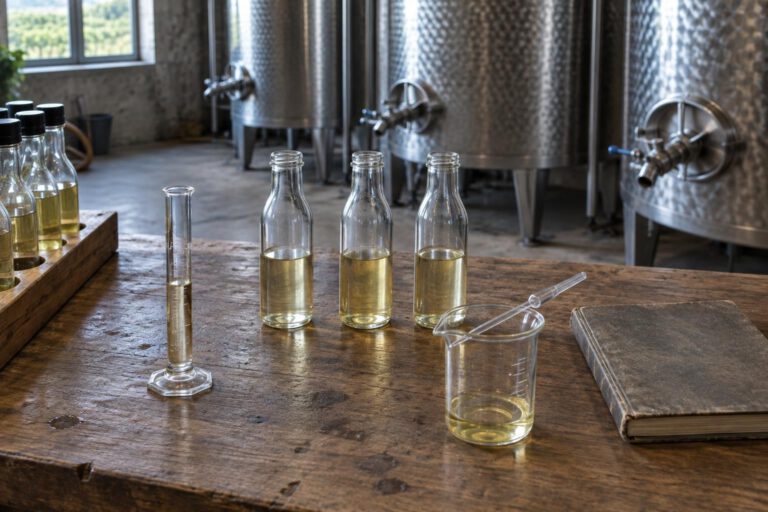
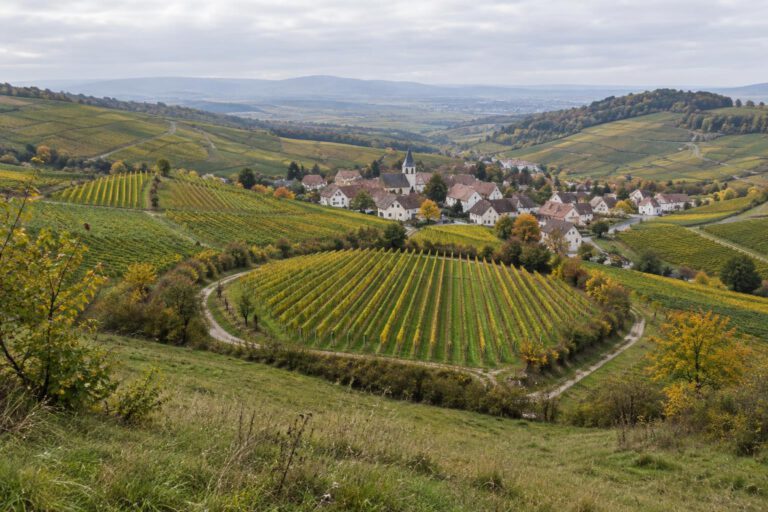
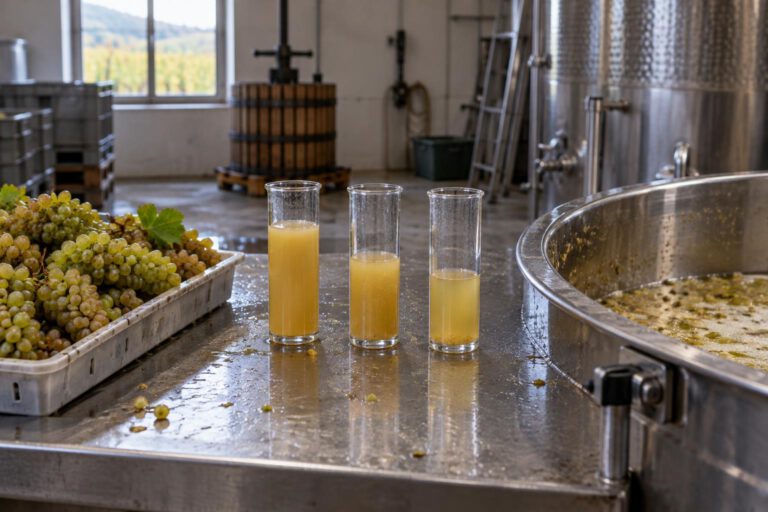
The 2026 harvest began unusually early in Austria, shifting the rhythm of autumn operations. Tasks normally spread over several weeks were compressed into a tighter window: grapes have to reach the cellar at the right level of ripeness, with picking teams, transport and processing capacity all available. A small crop therefore does not automatically mean a quiet autumn.
Early budburst, early flowering and high summer temperatures accelerated vine development. At the same time, many areas lacked rain. In September, the Austrian Chamber of Agriculture expected a harvest of around 1.7 million hectolitres, more than 30 per cent below the previous year. That forecast was not a final harvest figure. Dry conditions reduced berry size in many vineyards; the chamber also pointed to differences between vineyards depending on soil, water-holding capacity and management.
A short autumn is an exercise in logistics
In Burgenland, early parcels had already been picked in August. ORF reported that the harvest in Seewinkel was drawing to a close in September, while the main harvest in Lower Austria, Styria and Vienna began in early September. Such regional staggering remains important: not every variety and every vineyard ripens at the same time. But when several parcels become ready to pick in quick succession, demand rises for people, vehicles and grape reception capacity available at short notice.
This changes workforce planning. Picking teams cannot simply be booked far in advance when weather and ripeness shift the optimum date. Producers need to make contingency arrangements and coordinate tasks more closely: who picks, who drives, who receives the grapes? With hand-picking, it is also important to get the crates out of the vineyard promptly. The precise arrangements differ from one producer to another, but the same principle applies to all: a tighter window leaves less room to absorb disruptions or delays.
The peak workload reaches the cellar
There is no pause after picking. Grapes have to be received, sorted and processed before the next batch arrives. When several picking dates converge, presses, fermentation vessels, cooling systems and available working hours all come under pressure at once. Lower yields may reduce the size of individual batches, but do not necessarily resolve the bottleneck: what matters is how much fruit reaches the cellar over how many hours.
Reports from the regions show how differently drought affected individual producers. In August, winegrowers in Burgenland reported considerable regional differences, depending in part on vine age and vineyard layout. At the end of October, Thomas Huber of Vienna’s Weingut Fuhrgassl-Huber put his harvest at 35 to 40 per cent below the long-term average. These are figures for individual businesses, not an Austria-wide assessment. Huber also reported that his estate was installing drip irrigation where infrastructure was available — a longer-term adaptation, not a short-term solution for the harvest already completed.
Planning becomes more flexible
The practical lesson is not to pick earlier everywhere by the same margin, but to make operations more flexible. That includes reliable ripeness checks, coordinated harvest plans and clear arrangements between vineyard and cellar. The question of which parcels take priority also becomes more important when staff or processing capacity are scarce. Spare transport and labour capacity can help, but come at a cost and are not equally available to every producer.
Industry representatives describe the vintage as promising; that is an assessment, not a conclusion based on tasting for this article. Regardless, the decisive organisational questions remain how early the next vintage develops and how ripening progresses across the regions. The lesson of 2026 is clear: the harvest date has long been more than a decision made in the vineyard. It determines when people are needed, how grapes are moved and whether the cellar can take in the crop without bottlenecks.
Original reviewed by the editors · 5 November 2026