A wine bottle bears a name. Behind it, we rightly look for decisions: about a grape variety, a harvest date, an approach to winemaking. Yet reading our articles this week, something else emerges. Much of what will make those decisions possible in future lies beyond the control of any individual estate.
My argument is therefore simple: anyone seeking to preserve provenance must also understand it as a shared responsibility. That does not diminish a winemaker’s individual signature. It simply takes seriously what that signature depends on.
Water does not respect property boundaries
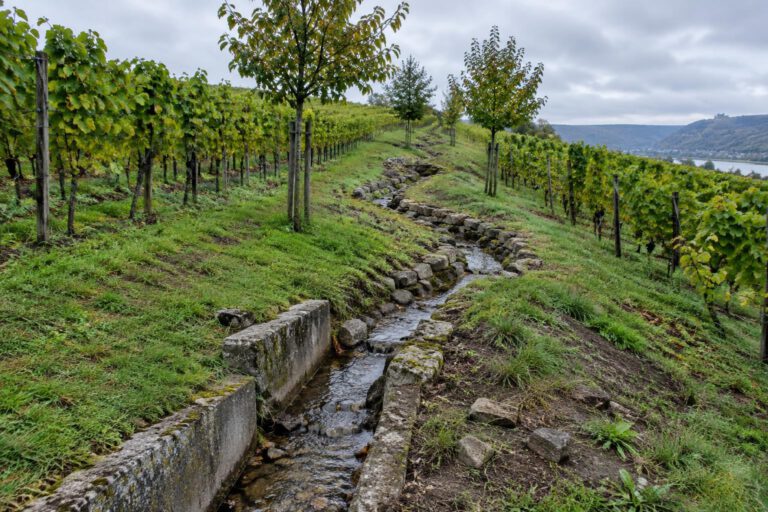
“Fuhrgassl-Huber rethinks its water supply” initially describes one estate’s response: the Viennese producer plans to install drip irrigation where wells or water networks are available. Details remain open. Alongside it is our article “Rain above the vines: who organises water retention?”. Here the perspective broadens. Drought and rainwater run-off cannot be considered solely within the boundaries of a single plot.
The practical guide commissioned by Zweckverband Rheingau is accordingly aimed at winegrowers, farmers, foresters and local authorities. That is more than an organisational footnote. The economic question is then not simply: what system can my estate afford? It is also: who coordinates the measures, who takes on maintenance, and how are the burdens shared?
I consider this second question just as important as the first. Individual adaptation remains necessary. But it must not become an excuse for setting aside responsibility for the shared landscape.
A map is not yet a shared understanding
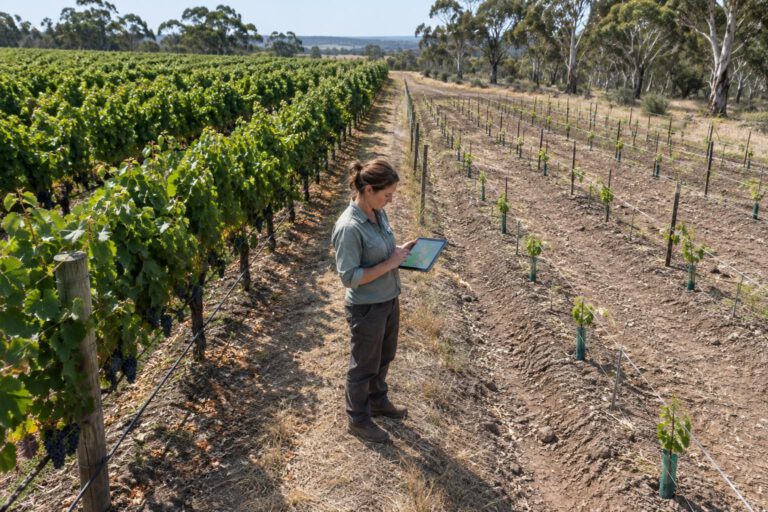
The conceptual journey from the Rheingau to Australia is shorter than the distance might suggest. The vineyard register planned there is intended to record the location, variety and size of plantings. Our background article on the subject shows the limits of the view from above: aerial images identify vineyards, but do not provide a complete account of what grows there.
Water and data are not the same thing. What they share, however, is that the perspective of an individual estate is not enough. A register needs information from many producers to build a useful overall picture. To my mind, this does not imply an obligation to disclose every business detail publicly. It does, however, mean establishing rules that those being asked to supply information can trust.
The strongest objection is obvious: another shared responsibility can mean another form to fill in. Another round of coordination takes time. Smaller estates in particular cannot meet every institutional expectation on top of their everyday work. This objection deserves more than a reference to benefits further down the line. Anyone asking for cooperation must also explain what work it will eliminate, who will have access and who will bear the costs.
Working together does not mean being the same
It would be wrong, though, to turn cooperation into an ideal of uniform wines. Our profile of Paul Fürst is about experience passed down within a family estate. Knowledge of this kind belongs to a particular place. It cannot be replaced by a database or decided upon at a regional meeting.
But that is no contradiction. Shared foundations can secure precisely the room in which different individual signatures can endure. A region does not need everyone to make the same cellar decisions. It needs agreements where individual decisions are not enough.
For me, this is the most important connection between this week’s articles: we should be less inclined to expect everything from the exemplary individual estate alone. That does not relieve anyone of responsibility; it distributes responsibility more precisely. The estate’s decisions are its own. Associations, local authorities and research institutions must play their part. Provenance deserves more than admiration for what makes it distinctive. It needs dependable cooperation to sustain what supports everyone.
Original reviewed by the editors · 7 November 2026